Tag: Mental Health

  • Acknowledging Grief for Your Former Physical Capacity

    Acknowledging Grief for Your Former Physical Capacity

    Grief can appear in ordinary moments: seeing old running shoes, remembering an effortless outing, or realizing that a familiar task now needs help. You can miss your former capacity while still valuing the life you have. Those feelings do not cancel each other out.

    Name what you are actually missing

    It may be movement itself, spontaneity, privacy, income, confidence, or the way an activity connected you with other people. Naming the loss can help you understand why a seemingly small reminder hurts so much.

    You do not need to immediately find a positive replacement. Sometimes the honest response is, “I miss that, and today it feels painful.” A trusted person can listen without turning the conversation into advice about acceptance.

    Explore continuity gently

    When you want to, consider whether any part of the old experience remains available in a different form: following a favorite team, making art on a smaller scale, or spending time with people who share an interest. These options do not erase the loss, and you are allowed to decline them.

    If grief becomes overwhelming or leaves you feeling persistently disconnected from life, professional support may help. There is no deadline for making peace with a changed body. You deserve room for sadness, interest, anger, affection, and all the other feelings that can coexist in an altered life.


  • Journaling Prompts for Chronic Illness Self Compassion

    Journaling Prompts for Chronic Illness Self Compassion

    Journaling can offer a place to speak honestly without making your feelings easier for someone else to hear. It can also feel like homework when you are exhausted. A sentence, a voice note, or a few words can be enough.

    Choose one question

    Try “What has been hardest today, and what would I say to a friend facing it?” Or “What support did I need that I did not receive?” If gratitude prompts feel forced, leave them out. You can write about frustration, boredom, grief, or an ordinary pleasant moment without balancing the page into a positive story.

    Another useful prompt is “What could make tomorrow slightly easier?” Keep the answer small and realistic: moving a charger, asking for a meal, or canceling an optional task. The page does not need to become a plan for fixing your life.

    Protect your privacy and capacity

    Choose a format that feels physically comfortable and store it where you want it kept. If writing or recording increases distress, stop and turn toward support or an external activity. You are not required to process difficult experiences alone.

    Read your words with as much kindness as you can manage. They are a record of one moment, not a verdict on your character. The purpose is to give your experience room, including on days when the only sentence available is, “This is hard, and I need care.”

  • Gentle Parenting on Low Energy Days

    Gentle Parenting on Low Energy Days

    Low-energy parenting can bring a particular kind of ache: you want to be present, but your body needs less noise, less movement, and more rest. A quieter day can still contain warmth, connection, and dependable care.

    Make a small menu of togetherness

    Keep a few options that work from a supported seat: reading aloud, listening to an audiobook, drawing side by side, or letting your child tell you the story behind their toys. A familiar show together can also be a practical choice. You do not have to make every hour educational.

    Try a simple explanation: “My body needs a slower day. I still want to spend time with you. Would you like a story or some drawing?” Offer choices that are actually manageable for you.

    Ask adults for adult help

    Children can have age-appropriate household roles, but they should not become responsible for managing your symptoms or keeping you medically safe. If you may faint, need to sleep, or cannot supervise safely, arrange another responsible adult where possible. Keep medicines and other hazards secured even when resting spaces change.

    Food, safety, affection, and enough structure for the day are meaningful priorities. Elaborate activities can wait. If guilt arrives, imagine how you would speak to another parent in the same situation. Your child does not need a parent who never needs care; they need relationships where care and limits can coexist.

  • Unpacking Guilt Around Household Chores

    Unpacking Guilt Around Household Chores

    A basket of laundry can carry more than clothes. It can hold expectations about adulthood, partnership, parenting, and who you used to be before symptoms changed your days. No wonder an unfinished chore can feel so personal.

    Separate a household need from a judgment

    “We need clean plates” is a practical problem. “I am failing because the kitchen is messy” is a painful conclusion. Try naming the smallest actual need: a clear path to the bathroom, clean clothes for tomorrow, or food put away safely.

    Make three loose groups: essential now, helpful later, and optional. Folding towels might be optional. Moving something that creates a fall hazard might be essential. Your list can change with your household and your capacity.

    Make help specific

    Instead of waiting until everything feels overwhelming, try: “Could you take out the trash tonight?” or “Can we agree that you handle the heavy laundry basket?” Clear ownership can reduce the exhausting work of repeatedly asking and supervising.

    Some days there is no spare help, and that is genuinely hard. Convenience items, simplified routines, and lower standards may be necessary accommodations rather than choices you would otherwise make. Your worth is not visible in a spotless room. A home is allowed to show that people live there, including people who need rest.

  • Maintaining Friendship Boundaries with Illness

    Maintaining Friendship Boundaries with Illness

    Friendship can be a source of comfort and still need boundaries. When your capacity changes, you may miss the ease of saying yes without calculating travel, noise, recovery, or the cost of a long conversation.

    Be specific about what remains possible

    Instead of a yes that you dread or a no that feels final, try offering a smaller option: “I can’t manage dinner out, but I would love a short call.” Or: “You’re welcome to visit, but I’ll need to stay on the sofa and keep it brief.”

    You can also ask for a kind of contact that does not require an immediate response. A photo, a voice message, or a shared joke can keep a thread of connection alive when a full conversation is too much.

    Leave room for honest feelings

    Friends may feel disappointed, and you may too. Disappointment does not automatically mean a relationship is unsupportive. Repeated pressure, disbelief, or punishment for reasonable limits is different and may require a firmer conversation or distance.

    Try stating the boundary without debating your symptoms: “I understand you wish I could stay longer. I still need to leave now.” You are allowed to protect your capacity while caring about someone else. A friendship does not have to look exactly as it once did to remain meaningful, but your needs deserve a place in its new shape.

  • Handling Unsolicited Health Advice Gracefully

    Handling Unsolicited Health Advice Gracefully

    Unsolicited health advice can arrive wrapped in concern and still feel exhausting. You may have heard the same supplement, diet, or exercise suggestion many times, often from someone who has not asked what living with your condition is actually like.

    Choose the amount of conversation you want

    A brief response can be enough: “Thank you for thinking of me. I’m following a plan with my care team.” If you want to redirect: “What would help most today is some company, rather than treatment suggestions.”

    For repeated advice, a clearer boundary may be needed: “I’m not discussing new remedies. Please stop sending them.” You do not have to provide a research review or disclose your medical history to make that boundary valid.

    Keep support separate from persuasion

    Someone can care about you and misunderstand your needs. If the relationship matters, describe a concrete alternative: bringing a meal, helping with an errand, or listening without trying to solve the illness. Their response will give you useful information about what support is available.

    You are also allowed to end the conversation. Save your questions about a proposed treatment for a qualified clinician or pharmacist who can consider your circumstances and medicines. Declining advice is not declining hope. It can be a way of protecting the limited attention and energy you need for your actual life.

  • Delegating Tasks Without Guilt

    Delegating Tasks Without Guilt

    Delegating can feel strangely uncomfortable when you are used to being the person who notices, organizes, and finishes everything. Asking for help may bring guilt even when the task is clearly beyond your current capacity.

    Hand over a complete piece

    Try naming the outcome rather than offering a vague request: “Could you handle dinner on Tuesday, including deciding what we eat and cleaning up?” That allows the other person to take responsibility rather than waiting for you to direct every step.

    Agree on the few things that truly matter, such as safety, dietary needs, or a deadline. If the towels end up folded differently, consider whether that difference needs your energy. Letting someone use their own method can be part of making help sustainable.

    Make the agreement visible

    For shared households, a simple list of responsibilities may reduce repeated negotiations. Review it when health, work, or caregiving demands change. Children can contribute in age-appropriate ways, but adult care and medical responsibility should stay with adults.

    Not everyone has a reliable support network, and advice to delegate can feel hollow when help is scarce. In that situation, simplifying or leaving an optional task undone may be the available choice. Your need for help remains valid even when others cannot meet it. Receiving support is part of human life, not a debt you must repay by overextending yourself later.

  • Unlearning Guilt Around Rest Days

    Unlearning Guilt Around Rest Days

    Rest can feel surprisingly difficult when you have learned to measure a good day by what you finish. Even lying down may become crowded with thoughts about messages, laundry, work, and all the things you believe you should be doing instead.

    Notice the rule behind the guilt

    Ask yourself what you are being told internally: “Rest is only allowed after everything is done,” or “Other people need me, so my needs must wait.” Those rules may be familiar without being fair or workable.

    Try replacing the rule with a practical statement: “My body needs a pause, and the list will still be there afterward.” You do not have to feel convinced immediately. A kinder sentence can be something you practice rather than something you already believe.

    Let rest be ordinary

    Choose a place where you can settle and reduce one demand if possible. Put the task list out of view, ask someone else to answer the door, or leave a message saying you will respond later. Rest does not need to be aesthetically pleasing or optimally restorative.

    You may still feel frustrated, bored, or sad while resting. Those feelings do not cancel its legitimacy. If guilt is persistent or tangled with anxiety, a supportive therapist may help you explore it. You do not need to become perfectly accepting of illness before you are allowed to care for yourself.

  • Sensory Rest: Creating a Low Stimulation Sanctuary

    Sensory Rest: Creating a Low Stimulation Sanctuary

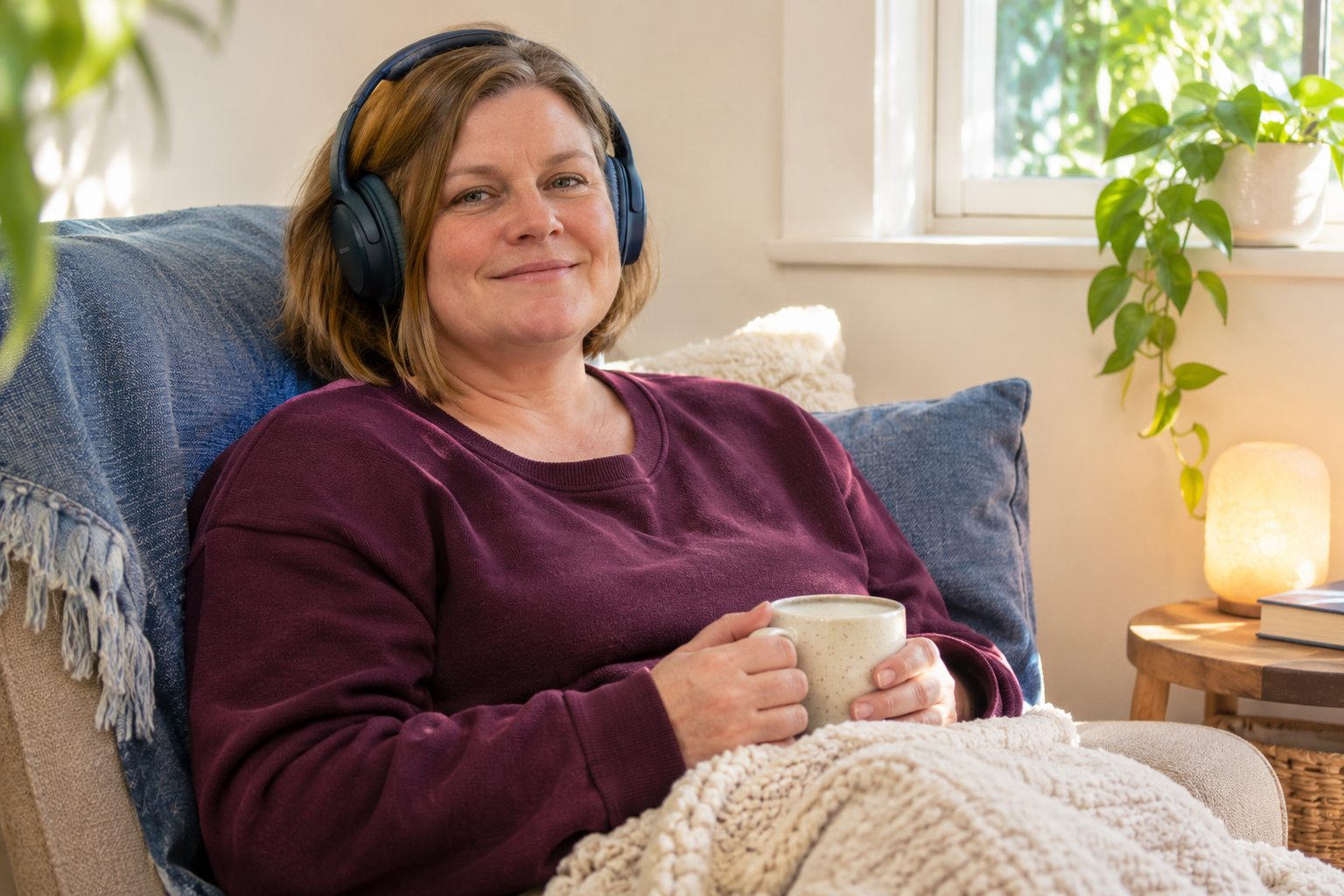
    Sometimes the most appealing form of self-care is less: less light, less noise, fewer decisions, and nobody asking what comes next. A low-stimulation space can give you somewhere to pause without requiring a complete redesign of your home.

    Build around one comfortable place

    Choose a chair, bed, or sofa you already use. Add only what makes settling easier: a pillow, a familiar blanket, water within reach, or a way to adjust the light. Keep the route clear and avoid adding objects that create more tidying or reaching.

    Consider scent as well as sound and brightness. An unscented space may be more comfortable than candles or diffusers, especially when migraine, nausea, or respiratory sensitivity is present. Soft music is optional; silence is optional too.

    Tell others what the space means

    If you share a home, agree on a simple signal for a quiet interval. You might ask for messages instead of being called across the room, while keeping important alarms and caregiving needs in mind. A sanctuary does not have to mean being unreachable.

    The space may help you feel more settled without changing the underlying symptoms. That still has value. If you cannot create a separate corner, one small adjustment—a dimmer lamp, a closed door, or a softer layer—can be enough for today. You do not need a picture-perfect room to deserve quiet.